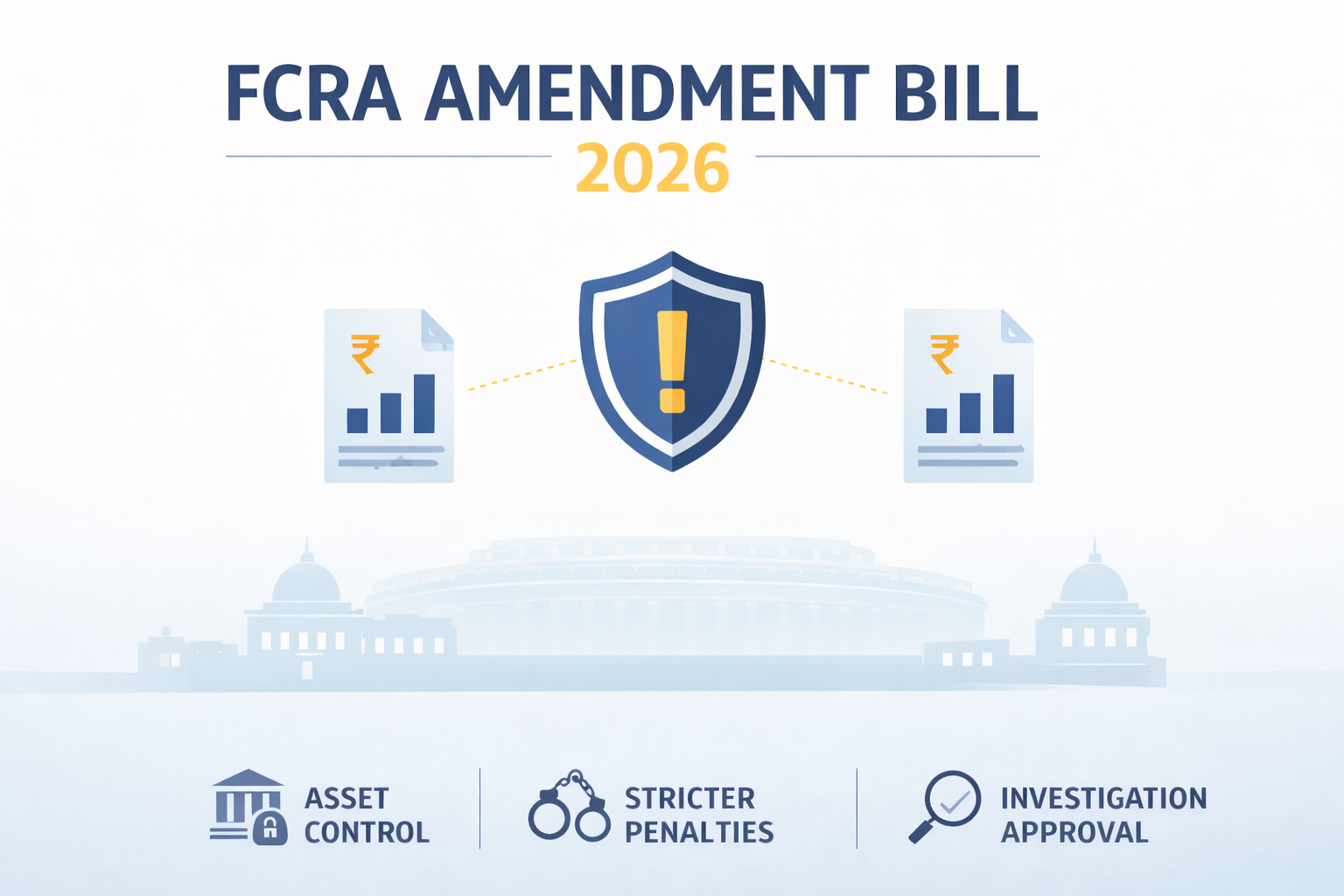
The Foreign Contribution (Regulation) Act, 2010 regulates the acceptance and use of foreign contributions in India. The Foreign Contribution (Regulation) Amendment Bill, 2026 has been introduced to amend the 2010 Act and fill certain operational and legal gaps.
The main objective of the Bill is to create a statutory framework for the supervision, management, and disposal of foreign contributions and related assets. This becomes particularly relevant where an organisation’s registration is cancelled, surrendered, or ceases to exist.
Updated Legal References
The Bill brings FCRA references in line with the new legal codes:
- References to the Code of Criminal Procedure, 1973 are replaced with the Bharatiya Nagarik Suraksha Sanhita, 2023.
- References to the Indian Penal Code are replaced with the Bharatiya Nyaya Sanhita, 2023.
- References to the Companies Act, 1956 are updated to the Companies Act, 2013.
New Definitions
Two new administrative roles have been defined:
- Administrator: appointed by the Central Government.
- Designated authority: appointed by the Central Government to oversee asset management.
A definition for “key functionary” has also been inserted. It includes:
- Directors of companies
- Partners in firms
- Trustees
- The Karta of a Hindu undivided family
- Other office bearers or managing committee members
Note that this definition is broad and brings a wide set of persons within the scope of personal liability u/s 39 (discussed below).
Certificates and Prior Permissions
The Bill tightens the rules on registration and prior permissions:
- A certificate of registration is valid for exactly five years.
- Prior permissions are limited to a specific purpose or amount.
- Funds received under prior permission must be received and utilised within a prescribed timeframe.
A new Section 14B introduces the concept of “cessation”. A certificate is deemed to have ceased on the expiry of its validity if:
- An application for renewal is not made, or
- The application is refused, or
- The certificate is not renewed before the deadline.
Once the certificate ceases, the entity cannot receive or utilise foreign contributions.
Restrictions During Suspension
Organisations with suspended certificates cannot alienate, encumber, or otherwise deal with assets created out of foreign contributions. Any such dealing requires the prior approval of the Central Government.
Asset Management under Chapter IIIA
Section 15 is omitted entirely and replaced with a new Chapter IIIA on asset management.
The working of the chapter:
- If an entity’s certificate is cancelled, surrendered, or ceases, its foreign contributions and related assets will provisionally vest in the Designated authority.
- If the organisation fails to obtain a fresh certificate or renewal within the prescribed period, the assets will vest permanently in the Designated authority.
- The authority may then transfer the assets to the government or dispose of them through sale.
- Proceeds from any sale will be credited to the Consolidated Fund of India.
Safeguard for Places of Worship
A specific safeguard has been included. If an asset that vests in the Designated authority is a place of worship, its management will be entrusted to an eligible person in a manner that maintains its religious character.
Revised Penalties
Section 35 is substituted to rationalise the punishment regime:
- Contraventions of the Act are now punishable with imprisonment of up to one year, or fine, or both.
- Earlier, the maximum imprisonment was five years.
Extended Corporate Liability
Section 39 is amended to widen personal liability. Where an offence is committed by an organisation, every key functionary in charge at the time is deemed guilty and liable to be punished.
The defences available are limited. The key functionary must prove:
- The offence happened without their knowledge, or
- They exercised due diligence to prevent it.
Prior Approval for Investigations
A new safeguard has been added u/s 43. No investigation into offences punishable under the Act can be initiated without the prior approval of the Central Government.
Some Points to Note
- The Bill significantly changes the framework for dealing with foreign funded assets post cancellation or cessation.
- Personal liability on office bearers and trustees has been widened through the new “key functionary” definition.
- The reduction in imprisonment from five years to one year rationalises the penalty, relief?
- The requirement of prior central government approval for investigations adds a procedural check against misuse at lower levels.