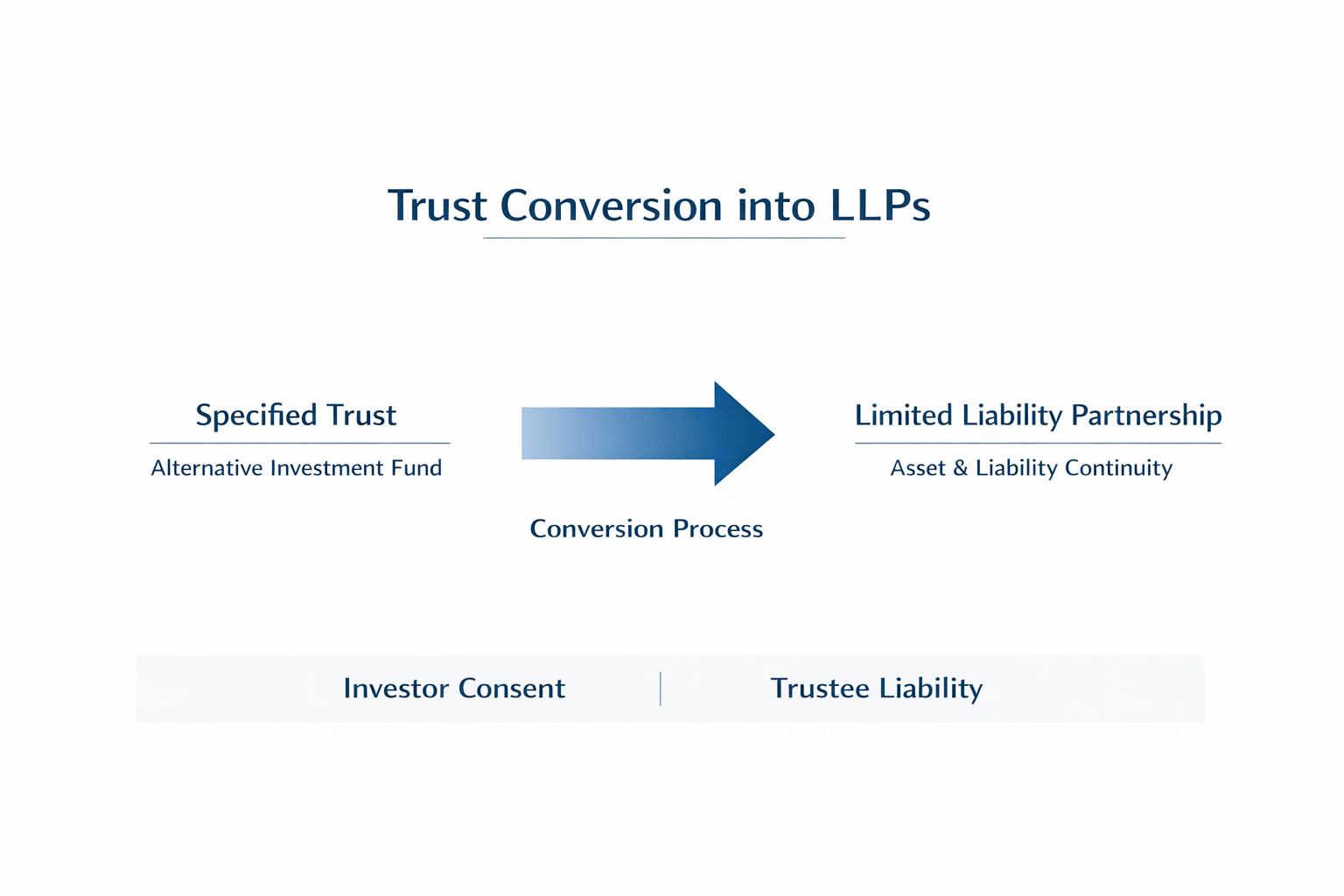
In a significant move to ease doing business, the proposed Corporate Laws (Amendment) Bill, 2026, introduces a provision allowing “specified trusts” to convert into Limited Liability Partnerships (LLPs). This amendment to the Limited Liability Partnership Act, 2008, aims to facilitate the conversion of Alternative Investment Funds, currently formed as trusts, into the more flexible LLP format.
What is a “Specified Trust”? Under the newly proposed Section 57A of the LLP Act, a “specified trust” is a trust established under the Indian Trusts Act, 1882, or any other Central or State Act. To qualify for conversion, the trust must be registered by the Securities and Exchange Board of India (SEBI) or the International Financial Services Centres Authority (IFSCA) and engage in prescribed activities.
The Conversion Process: Introducing the Fifth Schedule To govern this transition, the Bill introduces the “Fifth Schedule” to the LLP Act, which lays down strict conditions and procedures for conversion:
- Eligibility: A specified trust can only convert into an LLP if the partners of the new LLP are strictly the trustees of the specified trust, and no one else.
- Filing Requirements: The trust must file a statement by all its trustees with the Registrar, detailing the trust’s name, registration number, and dates of establishment and registration.
- Investor Consent: A critical prerequisite for this transformation is obtaining the explicit consent of three-fourths of the trust’s investors.
- Registration: Once satisfied with the documents, the Registrar issues a certificate of registration. The new LLP must inform the original registering authority (under the Indian Trusts Act or other relevant law) of the conversion within fifteen days.
Legal and Operational Effects of Conversion The process ensures a smooth transition without disrupting ongoing operations:
- Asset and Liability Transfer: On the date of registration, all tangible and intangible properties, assets, rights, privileges, and obligations of the specified trust automatically transfer to and vest in the new LLP without requiring any further deed or act.
- Dissolution of Trust: Upon successful conversion, the original specified trust is deemed to be dissolved and removed from the records of its respective registering authority.
- Continuity of Operations: All existing contracts, agreements, and employment contracts subsisting before the conversion continue in full force, with the LLP simply replacing the trust as the relevant party or employer.
- Legal Proceedings: Any pending lawsuits, arbitrations, or legal proceedings by or against the trust can be continued, prosecuted, and enforced by or against the new LLP.
Post Conversion Obligations and Trustee Liability While the LLP offers limited liability, the Bill ensures accountability for past actions. Every trustee remains personally liable, jointly and severally with the LLP, for any liabilities incurred before conversion. If a trustee pays any such liability, they are entitled to full indemnification by the LLP.
To ensure transparency, the new LLP must state in all official correspondence for twelve months that it was converted from a specified trust, including the trust’s original name and registration number. Failure to comply attracts a fine from Rs. 10,000 to Rs. 1,00,000, plus a continuing daily fine of Rs. 50 to Rs. 500.
Conclusion By amending Section 58 and introducing the Fifth Schedule, the Corporate Laws (Amendment) Bill, 2026, provides a robust, legally sound pathway for trusts, especially Alternative Investment Funds, to adopt the corporate advantages of an LLP. This aligns with the broader regulatory goal of adapting to evolving corporate landscapes, recognizing new structures, and strengthening operational efficiency in India.
This article summarizes proposed reforms under a draft Corporate Laws (Amendment) Bill, 2026, based on policy discussions and committee recommendations. These provisions are not yet enacted law.